
About Canada
Before deciding to move, it helps to understand the country itself: how the systems work, what the benefits actually cover, which industries are genuinely short of people, and how much the provinces differ. What follows aims to be balanced — the advantages, and the parts you pay for yourself.
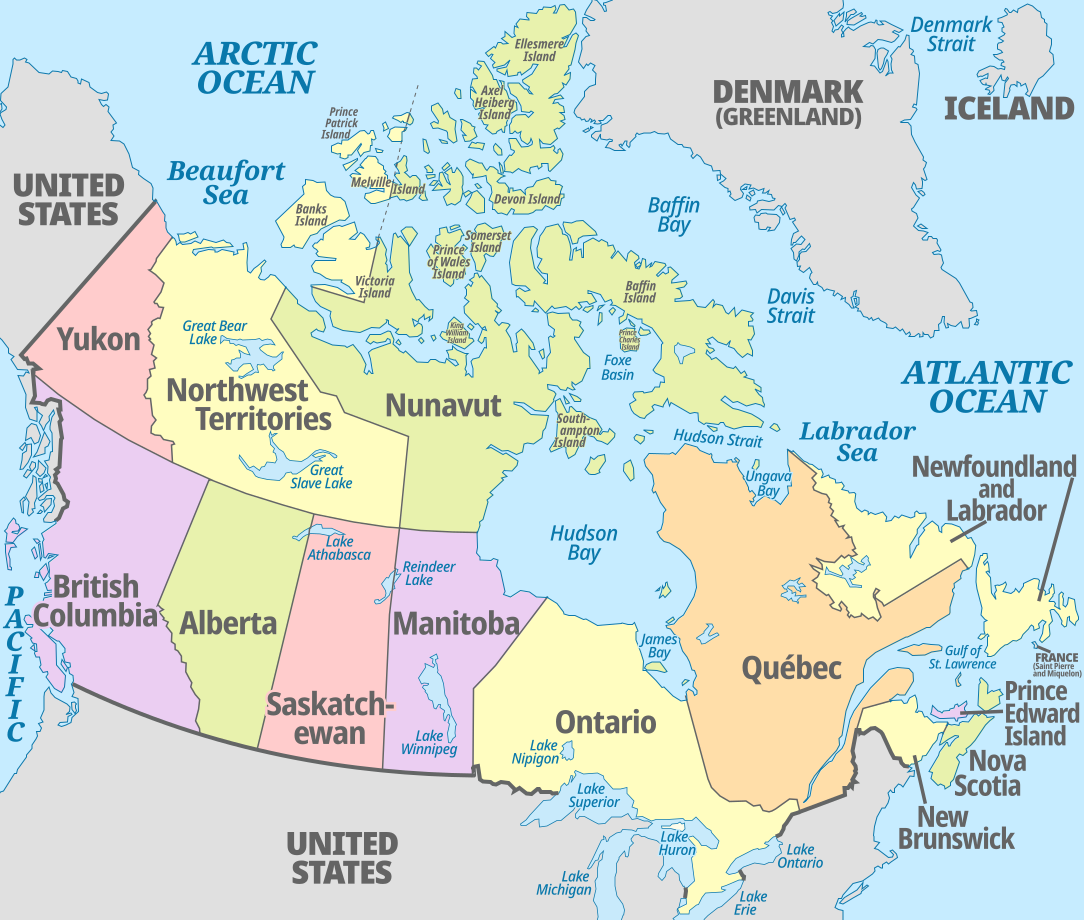
Drag and zoom; click a province to see its nominee program. Map data: Natural Earth (public domain)
Country overview
- Area
- About 9.98 million km², second largest on earth
- Population
- About 41.4 million (April 2026)
- Jurisdictions
- 10 provinces, 3 territories
- Capital
- Ottawa, Ontario
- Official languages
- English and French
- Currency
- Canadian dollar (CAD)
- System of government
- Federal parliamentary democracy
- Time zones
- Six across the country
Health care: what is covered and what is not
Canada's public health insurance, Medicare, is administered separately by each province and territory. Permanent residents and eligible long-term residents apply for a provincial health card; family doctor visits, specialist care and hospital treatment are then paid from public funds with nothing due at the point of service.
- Covered: medically necessary physician services, hospital stays and surgery
- Usually not covered: outpatient prescription drugs, dental, vision, physiotherapy and ambulance services, which come through employer plans or out of pocket
- For new arrivals: British Columbia, Ontario and some other provinces apply a waiting period of up to three months, so private interim coverage is advisable
- In practice: public coverage does not mean instant access — family doctors are scarce in some regions and specialist and elective procedures involve waiting
Education, from school to university
Public schooling is free for residents from kindergarten through grade 12. At university, citizens and permanent residents typically pay around a third of international student fees, and every province runs grant and student loan programs.
- Schools: free public education, with placement by residential catchment
- Post-secondary: universities and colleges both matter, with colleges offering job-focused diploma programs
- International students: eligible graduates can obtain a post-graduation work permit and build the Canadian experience that immigration programs reward
- Language support: provinces fund free or low-cost English and French classes for newcomers, such as LINC
Social benefits and family support
Canada's tax-funded benefits follow people through raising children, unemployment and retirement. Most are for permanent residents and citizens, and some require a minimum period of residence.
- Canada Child Benefit: a tax-free monthly payment for families with children under 18, scaled to income
- Employment Insurance: income support during unemployment, parental leave and sickness, subject to insurable hours
- Retirement: the Canada Pension Plan and Old Age Security, the latter generally requiring 10 years of residence after age 18
- Parental leave: parents can share up to roughly 18 months, partly paid through Employment Insurance
- Low-income support: provincial social assistance, housing subsidies and the GST/HST credit
The job market and demand for immigrants
With an ageing population and a low birth rate, essentially all of Canada's labour force growth comes from immigration — the structural reason the policy stays open. The federal Immigration Levels Plan holds permanent resident admissions at 380,000 a year from 2026 to 2028, with the economic share rising to 64% in 2027 and 2028, the highest in decades.
- Persistent shortages: health care, skilled trades and construction, education and early childhood, transport, agriculture and food processing
- Regional differences: BC and Ontario lean on technology, finance and film; Alberta and Saskatchewan on energy, agriculture and manufacturing; the Atlantic provinces and territories on health care, fisheries, tourism and local services
- Rural preference: most provinces award extra weight to jobs in smaller communities, where the bar is noticeably lower than in the big cities
- Licensing: doctors, nurses, teachers and many trades are regulated, and provincial certification is required before practising
Geography and resources
Canada covers about 9.98 million square kilometres across six time zones, from temperate rainforest on the Pacific coast to tundra inside the Arctic Circle. It holds roughly a fifth of the world's fresh water and ranks among the leading countries for forests, oil and gas, potash and a range of metals.
- Where people live: roughly 80% of the population lives within 150 km of the United States border
- Climate: Vancouver and Victoria have mild, wet winters; the prairie provinces are cold and dry; the east has four distinct seasons
- Environment: an extensive national park system, with air and water quality consistently among the best in the developed world
- Resource industries: energy, mining, forestry and agriculture drive exports and supply much of the demand behind the prairie and territorial nominee programs
The major cities
Vancouver, BC
The mildest climate of any large Canadian city, with an established Chinese community and an economy built on technology, film, trade and tourism. Housing and living costs are among the highest in the country.
Toronto, ON
The largest city and financial centre, with the widest range of jobs and industries and a very high immigrant population — and living costs to match.
Montreal, QC
A French-speaking international city where living costs are clearly lower than in Vancouver or Toronto, strong in aerospace, artificial intelligence and culture.
Calgary, AB
The centre of the energy industry, with no provincial sales tax and lower personal income tax, growing technology and finance sectors and comparatively moderate housing costs.
The provinces and territories
Listed west to east. Those with a nominee program link through to its requirements.
- British Columbia (BC)Pacific coast, mild climate, strong technology and trade
- Alberta (AB)Energy heartland, lower taxes, moderate living costs
- Saskatchewan (SK)Agriculture and mining, with comparatively accessible criteria
- Manitoba (MB)Manufacturing and transport hub that rewards local ties
- Ontario (ON)Largest province by population and economy; its program was rebuilt in 2026
- Quebec (QC)French-speaking, with its own immigration system outside the PNP
- Nova Scotia (NS)The largest Atlantic economy, with steady health care and ocean sector demand
- Prince Edward Island (PE)The smallest province; selection strongly favours those already working there
- New Brunswick (NB)Canada's only officially bilingual province, with a francophone pathway
- Newfoundland and Labrador (NL)Island province prioritising health occupations, with a low provincial bar
- Yukon (YT)Employer-driven, with only two intake windows a year
- Northwest Territories (NT)Mainly employer-driven, with points for small-community jobs
- Nunavut (NU)The largest and least populated territory; no nominee program
Note: Quebec and Nunavut do not run nominee programs. Under the Canada–Quebec Accord, Quebec selects its own economic immigrants.
This page summarises public information from federal and provincial governments for general reference. Benefit and health coverage follow the current rules of your province, and admission targets and policies change every year — always check IRCC for the latest.